Uniformity
Perceived colors
The human eye contains only three types of cone cells, so the physical aspect of a color can be unambiguously specified using three measurements. However, these measurements do not completely describe how a color appears because colors are not perceived in isolation. Color appearance depends on ambient lighting, the background against which the color is viewed, and the chromatic adaptation of the observer. (For a thorough treatment of color appearance, see [Fai13].) High-quality color maps for continuous data are often designed around the principle of “perceptual uniformity,” meaning perceived differences in colors should be proportional to differences in data values. This principle has a long history [BTS+18] and is supported by both experience and experiment [Bre94] [SKR99] [War88].
Perceived colors are quantified using color appearance models. Most color appearance models define six parameters, called “correlates,” that represent distinct facets of color perception. The absolute amounts of light and color perceived to come from an object are called brightness and colorfulness, respectively. Hue distinguishes colors of equal brightness and colorfulness. The other three correlates are proportions. Saturation is the ratio of an object’s colorfulness to its brightness. Lightness and chroma are the ratios of an object’s brightness and colorfulness to the brightness of a similarly illuminated white object.
The correlates most relevant to color map design are lightness, chroma, and hue. If the color map is viewed under controlled conditions, then these three correlates determine a unique color, and unlike brightness, colorfulness, and saturation, they are under the direct control of the color map designer. However, the relation between perceived color differences and measured values of these correlates is indirect. When designing color maps, it is helpful to parametrize colors so that perceived color difference is proportional to coordinate distance. Such a parametrization is called a uniform color space [CommissionIdLEclairage20].
Uniform color spaces are only suitable for color map design when the color map is used on data that is suited to a linear scale. We will tacitly assume this throughout. Other data should be transformed first.
Perceptual uniformity
Mathematically, a color map is a function \(\cc\) that chooses, for each data value \(x\), a color \(\cc(x)\). We will always assume that we have chosen a uniform color space to work in and that \(\cc(x)\) is represented using coordinates in that space. When we need to discuss the rate at which correlates change, we will assume that the tangent vector \(\cc'(x)\) exists.
When interpreted strictly, perceptual uniformity is an extremely restrictive condition on a color map. If the color map is perceptually uniform, then the values of \(\cc(x)\) make a line. To understand why, consider three data values, \(x_1\), \(x_2\), and \(x_3\). Perceptual uniformity means that the distances between \(x_1\) and \(x_2\), \(x_2\) and \(x_3\), and \(x_1\) and \(x_3\) are proportional to the distances between \(\cc(x_1)\) and \(\cc(x_2)\), \(\cc(x_2)\) and \(\cc(x_3)\), and \(\cc(x_1)\) and \(\cc(x_3)\), respectively. The distance between \(x_1\) and \(x_3\) is the sum of the distances between \(x_1\) and \(x_2\) and between \(x_2\) and \(x_3\), so the distance between \(\cc(x_1)\) and \(\cc(x_3)\) must be the sum of the distances between \(\cc(x_1)\) and \(\cc(x_2)\) and between \(\cc(x_2)\) and \(\cc(x_3)\). Elementary geometry therefore implies that \(\cc(x_1)\), \(\cc(x_2)\), and \(\cc(x_3)\) are all on a line. Since this is true of any three data values, a perceptually uniform color map is a line in a uniform color space.
However, a line in a uniform color space may be a terrible color map. For example, the following color map is a line in the uniform color space CAM16-UCS [LLW+17], so it is perceptually uniform:

This color map has a short magenta region, an achromatic region, and a long green region. Because this color map is asymmetric, it tends to color data green. It makes even pure noise appear mostly green. This preponderance of one color gives the viewer the false impression that the data is skewed.
A different problem with lines in a uniform color space is illustrated by the following color map:

The ends of this color map are distractingly colorful, and there is evidence that this makes the color map harder to use. This color map is similar to the bipolar color map tested by [SKR99]. In their experiments, subjects performing identification tasks were slower and less accurate when using a bipolar color map than when using a color map that varied only in lightness or that varied linearly in hue, lightness, and chroma.
Every color map made from a line in a uniform color space suffers, to some extent, from the same problems as the color maps above. The failures of these two color maps suggest that perceptual uniformity does not adequately describe every desirable quality of a color map. This is perhaps one reason why none of the high-quality color maps cited in the introduction are lines in a uniform color space.
Other types of uniformity
Color maps that are advertised as being perceptually uniform are usually uniform only in their lightness component. Their lightness increases (or decreases) at a constant rate, a property we will call lightness uniformity. When data is presented using a lightness-uniform color map, viewers who can accurately perceive lightness can accurately gauge the magnitude of data.
But as [War88] observed, an optical illusion called the simultaneous contrast effect makes it difficult to judge lightness. This effect makes the same gray patch appear light when against a dark background and dark when against a light background. In Ware’s experiments, subjects attempted to match a region in a high-contrast test image to a key. The subjects performed poorly when the test image was grayscale. They made fewer errors when the same data was colored with a large number of identifiable hues. Ware recommended that color maps use lightness to convey form information (level sets or contour lines) and hue to convey metric information (data values). Other suggestions that lightness plays an important part in form perception have come from experiments with isoluminant (constant lightness) variants of optical illusions [Gre77].
Studies of human contrast sensitivity suggest a physical basis for Ware’s recommendations. Human vision is sensitive in different ways to low-frequency and high-frequency contrasts. Achromatic sinusoidal lightness patterns are visible until they oscillate at more than 60 cycles per degree of visual field, after which moiré patterns appear [Wil85]. Sinusoidal chromatic patterns are only visible up to a maximum of around 10 cyc/deg (the exact maximum depends on the colors involved) [AMH91] [KRHM18] [Mul85] [SC99] [Swi08]. But at frequencies below about 0.5 cyc/deg, contrasts in chromatic sinusoids are more visible than contrasts in achromatic ones [KRHM18] [Mul85]. High-frequency information, therefore, is best displayed using lightness contrasts, while low-frequency information is best displayed using chromatic contrasts. This offers an explanation for the importance of lightness uniformity: Lightness uniformity ensures that a color map displays high-frequency information well, regardless of where the oscillations appear in the data’s range. It also suggests that, to display low-frequency information well, a good color map should have some kind of uniform chromatic variation.
There are several senses in which a color map might be chromatically uniform. We propose calling a color map hue-uniform if its hues change at a constant rate and chroma-uniform if its chroma changes at a constant rate.
Here are three examples. The first example is isoluminant, constant hue, and chroma-uniform. It follows the line in CAM16-UCS from (67, 0, 0) to (67, 40, −19):

The second example is isoluminant, hue-uniform, and constant chroma. This color map follows the circular arc in CAM16-UCS from (71, 25, −11) to (71, −2, −27). In polar coordinates, it begins at −24°, travels 288° counterclockwise, and ends at −96°:

The third example is isoluminant, hue-uniform, and chroma-uniform, and it has varying hue and chroma. This color map follows a spiral in CAM16-UCS from (59, 0, 0) to (59, 41, 21). In polar coordinates, it begins at 104°, travels 283° counterclockwise, and ends at 27°:

Being hue-uniform and chroma-uniform are not enough to guarantee that a color map accurately presents data. The spiral color map, for example, has the undesirable feature that colors near the beginning are closely spaced while those near the end are far apart. To understand the perceptual impact, take evenly spaced samples from the color map:

These swatches represent equally spaced data values. However, the two leftmost swatches are much closer in CAM16-UCS than the two rightmost swatches. This deceives the viewer into thinking that lower data values are closer together than higher data values.
The spacing of colors is controlled by \(\norm{\cc'(x)}\), the length of the tangent vector. Variation in \(\norm{\cc'(x)}\) causes variation in color spacing. We say that a color map has constant velocity when \(\norm{\cc'(x)}\) is constant. In constant velocity color maps, perceived distances between nearby colors are approximately proportional to perceived distances between nearby data values, and the constant of proportionality does not depend on the data values themselves. A perceptually uniform color map has constant velocity, but not vice versa, because constant velocity color maps do not guarantee anything about data values that are far apart.
Adjusting the spiral color map to have constant velocity yields the following:

But changing the velocity in this way also changes the rate at which the hue and chroma change. The following figures plot the hue and chroma of the above constant velocity spiral. The horizontal axis is distance from the left edge of the color map on a scale from zero to one. Hue angles were normalized to be between −270° and 90°:
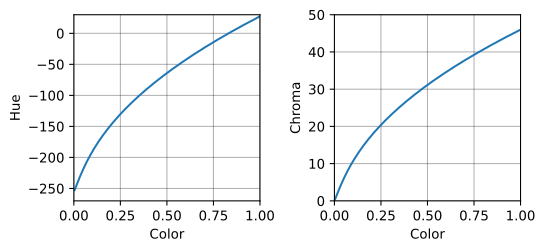
Both the hue and chroma increase much faster near the left end of the color map than the right end, so changing the spiral to have constant velocity has also made it neither hue-uniform nor chroma-uniform.
Criteria for a good color map
We believe that a high-quality color map should satisfy all of the following conditions:
The color map should be lightness-uniform, hue-uniform, and chroma-uniform.
The color map should have constant velocity.
There should be a large lightness difference between the ends of the color map.
There should be either a large hue difference, a large chroma difference, or both, between the ends of the color map.
These conditions ensure that the color map clearly displays low- and high-frequency variations in the data and accurately communicates distances between nearby data values. Some, though not all, of them have an extensive history [BTS+18]. However, they are also difficult to satisfy.
Most uniform color spaces are parametrized by a lightness coordinate and two chromaticity coordinates. Suppose that the color map is the function \(\cc(x) = (J(x), a(x), b(x))\), where \(J\) is the lightness coordinate and \(a\) and \(b\) are the chromaticity coordinates. Convert the chromaticity coordinates to polar coordinates by setting \(r(x) = \sqrt{a(x)^2 + b(x)^2}\) and \(\theta(x) = \atantwo(b(x), a(x))\). Hue uniformity means that \(\theta(x) = \alpha x + \beta\) for some \(\alpha\) and \(\beta\), while chroma uniformity means that \(r(x) = \gamma x + \delta\) for some \(\gamma\) and \(\delta\). These conditions imply:
This curve is called an Archimedean spiral. Elementary calculus implies that the length of the tangent vector is:
It is obvious that if \(\alpha \neq 0\) and \(\gamma \neq 0\), then the velocity changes as \(x\) does. Consequently the only way that a color map can be simultaneously hue-uniform, chroma-uniform, and constant velocity is if it has either constant hue or constant chroma.
A constant hue color map has the advantage of being perceptually uniform. Such color maps meet every uniformity criterion one could imagine. But constant chroma color maps, despite being perceptually non-uniform, are probably easier to read. The subjects in [War88] made more errors with color maps that were nearly constant hue than they did with color maps that had a wide spectrum of hues. For that reason, we focused our attention on constant chroma color maps.