The color maps
We constructed the Chromophile color maps using the principles described in the previous sections. These color maps are lightness-uniform, hue-uniform, constant chroma, and constant velocity. Hue uniformity and constant chroma are, as far as we are aware, unique to our color maps. ([Kov15] mentions this possibility in the context of cyclic color maps, but his design criteria ultimately lead him elsewhere.) The unique treatment of chroma inspired the name “Chromophile.”
The Chromophile color maps were designed in CAM16-UCS. When CAM16-UCS is transformed to cylindrical coordinates, the radial coordinate is denoted \(M'\), the angular coordinate is \(h\), and the height coordinate is \(J'\). We call \(M'\) the uniformized colorfulness and \(J'\) the uniformized lightness. We write \(\Delta J'\) for the difference between the greatest and least values of \(J'\) in the color map.
Except for the isoluminant color maps, all the Chromophile color
maps contain pairs of colors with large lightness differences.
However, some of the color maps do not contain pairs with large
hue differences. Some, such as cp_seq_red_pink_cw1, have
only modest hue differences, and a few, such as
cp_seq_green_green_cw, have a nearly constant hue. These
are for visualizations with other constraints on the color map,
such as legibility against a colored background. In most
circumstances, we recommend color maps with large hue
differences.
The Chromophile color maps had one additional perceptual constraint, legibility for people with color vision deficiency. Illegible color maps are bad color maps, and there is no reason to use, let alone design, a bad color map. Using the model of [MOF09] (as implemented in [MMP+22]) we evaluated the suitability of each color map for color vision deficient viewers and, if necessary, adjusted it to make its colors distinct for those viewers. Apart from a few instances described later, we discarded color maps where this could not be done. Viewers in whom one type of cone cell is unusual (anomalous trichromacy) or absent or non-functional (dichromacy) will perceive the Chromophile color maps differently from non-anomalous trichromats, but they should not have difficulty reading them. (Users who need a color map specifically optimized for color vision deficient viewers should see [NAR18].)
Each of the Chromophile color maps is defined by a small number
of parameters. For instance, our sequential color maps are
determined by the initial and final lightnesses, the chroma, the
initial hue angle, and the change in hue angle. The small number
of parameters made it possible to automatically generate and
optimize color maps. With a few exceptions, the Chromophile
color maps were optimized by fixing the colorfulness and varying
the hue angles to maximize the difference in lightness between
their endpoints. Color map optimization was done using
scipy.optimize.minimize() with the method parameter
set to trust-constr. While optimization is never a
substitute for visual evaluation, it is much easier than
hand-tuning.
All the Chromophile color maps are designed for continuous data. They are not meant for categorical features such as distinguishing different lines on a shared line plot.
The gray color map
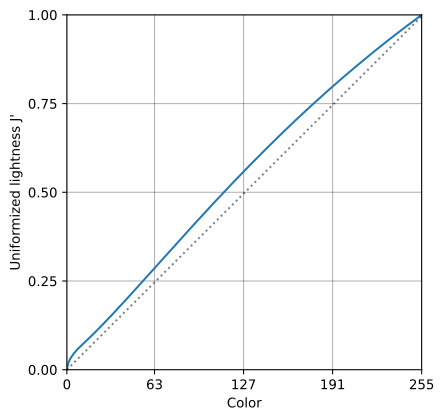
The standard sRGB grayscale color map is comprised of the colors with sRGB coordinates (0, 0, 0), (1, 1, 1), …, (255, 255, 255). This simplicity is deceptive, for the \(J'\) values of this color map are not linear in CAM16-UCS:
A secondary problem is that, as the lightness increases, the
color map steadily gains a slight cyan tint.
cp_seq_gray fixes both these issues. The difference
between the sRGB grayscale (top) and cp_seq_gray
(bottom) is small, but visible:


Sequential color maps
Sequential color maps are used when the data consists of real
numbers. There are fifteen sequential Chromophile color maps
(excluding order-reversed variants and cp_seq_gray).
They have systematic names of the form:
cp_seq_<starting color>_<ending color>_<direction><optional number>
The possible directions were cw and ccw
(referring to clockwise and counterclockwise directions in the
chromaticity coordinates of CAM16-UCS). Most color maps do not
have an optional number. For the ones that do, the number is
1 if the color map’s hues are confined to a small
sector and 2 if the hues span more than one but less
than two full circles.
All of the sequential color maps have 256 colors, \(M' = 20\), and \(\Delta J' \ge 80\). Because the sequential Chromophile color maps have a steady increase in lightness, they should be legible (though not optimal) for people with any type of color vision deficiency, even full monochromacy. The parameters of these color maps are:
Name |
\(J_0'\) |
\(J_1'\) |
\(\Delta J'\) |
\(h_0\) |
\(h_1\) |
\(\Delta h\) |
|---|---|---|---|---|---|---|
|
7.38 |
94.90 |
87.52 |
−77.15° |
197.44° |
274.59° |
|
7.38 |
94.90 |
87.52 |
−77.15° |
−162.56° |
−85.41° |
|
7.38 |
89.64 |
82.26 |
−77.15° |
−32.01° |
45.14° |
|
7.38 |
89.57 |
82.18 |
−77.15° |
−31.70° |
405.45° |
|
7.38 |
98.15 |
90.77 |
−77.15° |
111.96° |
189.11° |
|
7.85 |
98.15 |
90.31 |
−71.99° |
−248.04° |
−176.05° |
|
14.58 |
94.90 |
80.33 |
142.36° |
197.44° |
55.08° |
|
14.58 |
95.71 |
81.13 |
142.36° |
137.36° |
−5.00° |
|
14.58 |
98.15 |
83.58 |
142.36° |
111.96° |
−30.39° |
|
9.61 |
94.90 |
85.30 |
17.26° |
197.44° |
180.18° |
|
8.70 |
94.90 |
86.21 |
27.25° |
−162.56° |
−189.81° |
|
8.70 |
89.64 |
80.95 |
27.25° |
−32.01° |
−59.25° |
|
8.70 |
89.24 |
80.54 |
27.25° |
−33.49° |
−420.73° |
|
8.70 |
98.15 |
89.46 |
27.25° |
111.96° |
84.72° |
|
8.70 |
98.15 |
89.46 |
27.25° |
−248.04° |
−275.28° |
Here, \(J_0'\) and \(J_1'\) are the uniformized lightnesses of the initial and final colors, \(\Delta J'\) is their difference, \(h_0\) and \(h_1\) are the hue angles of the initial and final colors, and \(\Delta h\) is the change in hue angle along the color map.
The sequential color maps were found using a systematic search of directed arcs on a circle. The endpoints of each arc were used as the chromaticity coordinates of the endpoints of a color map. The initial lightness was set to \(J' = 20\) and the final lightness to \(J' = 80\). The color map was optimized to maximize \(\Delta J'\) under the constraint that the hue angles of the endpoints were near their starting points.
Among color maps whose hues made one or less full winding around the circle, there were 78 combinations of starting color, ending color, and direction. However, these led to only thirteen Chromophile color maps. The remaining color maps had too small a value of \(\Delta J'\) or were duplicates (exact or near) of the others. In every case, when a color map’s \(\Delta J'\) was too small, it was because the dark endpoint was not dark enough, and ultimately, that was because sRGB does not contain very dark browns and azures. There is little flexibility in the Chromophile color maps; a color map that goes clockwise from green to pink, for example, necessarily passes through brown. If the initial lightness is low, then those browns are so dark that they are not in sRGB, but increasing the initial lightness makes \(\Delta J'\) too small. This explains the small number of color maps starting at green: Any color map starting at green must avoid brown, so it cannot travel clockwise very far, and it must avoid azure, so it cannot travel counterclockwise very far, either. The only Chromophile color maps containing dark green have similar starting and ending hues, and their darkest colors are lighter than the darkest colors of the other Chromophile color maps.
Multi-sequential color maps
Multi-sequential color maps are used for data consisting of a real variable and a categorical variable. The categorical variable is used to select a sequential color map, and the real variable selects a color from that color map. Multi-sequential color maps are not often needed in practice, but an example can be seen in Figure 3h of [TGH+16].
Each sequence in each of the multi-sequential Chromophile color maps has 256 colors, so the full color map has between 512 and 1024 colors. Their names follow the pattern:
cp_mseq_<first color>_<second color>_<optional third color>_<optional fourth color>
Their parameters are:
Name |
\(J_0'\) |
\(J_1'\) |
\(\Delta J'\) |
\(h_0\) |
\(h_1\) |
\(\Delta h\) |
|---|---|---|---|---|---|---|
|
14.58 |
94.90 |
80.33 |
142.36° |
142.36° |
0.00° |
−89.66° |
−162.56° |
−72.90° |
||||
|
11.22 |
91.22 |
80.00 |
142.36° |
142.36° |
0.00° |
−32.81° |
−32.81° |
0.00° |
||||
|
11.22 |
91.22 |
80.00 |
142.36° |
142.36° |
0.00° |
25.00° |
−32.81° |
−57.81° |
||||
|
8.70 |
94.90 |
86.21 |
27.25° |
102.83° |
75.59° |
−79.67° |
−162.56° |
−82.90° |
||||
|
14.58 |
94.90 |
80.33 |
36.67° |
102.83° |
66.16° |
142.36° |
197.44° |
55.08° |
||||
|
8.83 |
89.64 |
80.82 |
−60.00° |
−32.01° |
27.99° |
27.47° |
86.82° |
59.35° |
||||
|
7.14 |
87.14 |
80.00 |
27.24° |
−14.85° |
−42.09° |
−79.90° |
−120.00° |
−40.10° |
||||
|
11.22 |
91.22 |
80.00 |
142.36° |
180.00° |
37.64° |
−32.81° |
−32.81° |
0.00° |
||||
|
8.88 |
89.64 |
80.76 |
27.57° |
86.82° |
59.24° |
−80.01° |
−142.99° |
−62.98° |
||||
−59.22° |
−32.01° |
27.21° |
||||
|
14.58 |
94.90 |
80.33 |
36.67° |
102.83° |
66.16° |
142.36° |
142.36° |
0.00° |
||||
−89.66° |
−162.56° |
−72.90° |
||||
|
11.22 |
91.22 |
80.00 |
36.62° |
88.11° |
51.50° |
142.36° |
142.36° |
0.00° |
||||
−87.57° |
−143.19° |
−55.62° |
||||
−32.81° |
−32.81° |
0.00° |
To find multi-sequential color maps containing two sequences, we
performed a systematic search, similar to the one for sequential
color maps, of pairs of directed arcs on a circle. This search
used \(M' = 20\), and we kept only color maps that achieved
\(\Delta J' \ge 80\). There was one exception,
cp_mseq_red_blue. The red and blue multisequential
color map that resulted from the search had colors that could not
be distinguished by some dichromats, and there seemed to be no
way to remove this ambiguity while meeting our other
requirements. Red and blue are such a popular pairing that we
kept this color map anyway. We re-optimized, this time
restricting the endpoints to ensure legibility for color vision
deficient viewers, requiring \(\Delta J'\) to be at least
80, and aiming to make \(M'\) as large as possible.
The final \(M'\) was 18.15.
A similar search of triples of directed arcs found
cp_mseq_orange_blue_purple and
cp_mseq_orange_green_blue. Searching quadruples
resulted in no color maps that achieved \(M' = 20\) and
\(\Delta J' \ge 80\).
cp_mseq_orange_green_blue_purple was produced by
imposing the constraint \(\Delta J' \ge 80\) and maximizing
\(M'\). The result was \(M' = 17.65\).
The multi-sequential Chromophile color maps with two sequences should be legible for dichromats. Those with three or four sequences should be legible for anomalous trichromats but are probably not legible for dichromats. It is possible to design a color map with three or four sequences of colors that all appear distinct to a dichromat. Two of the sequences would appear very colorful and the others would have the same colors but appear more gray. However, it seems difficult, maybe impossible, to do this simultaneously for all the different types of dichromats while meeting the other criteria for Chromophile color maps.
Divergent color maps
Divergent color maps, sometimes called bipolar color maps, are a type of multi-sequential color map. They are used when the data consists of real numbers, one of those numbers is the boundary between two qualitatively different categories, and the visualization should communicate distance from the boundary. This situation often arises when plotting differences.
Divergent color maps are not a substitute for contour lines. If the boundary value has no special meaning, then divergent color maps are unnecessary and may even be deceptive.
Some divergent color maps can also be used as sequential color maps (for example, [Mor09] was designed with that goal in mind). The divergent Chromophile color maps were not intended for this and should not be used for sequential data.
Each divergent Chromophile color map consists of two sequential color maps of 256 colors each, for a total of 512 colors. There are two types of divergent Chromophile color maps. One type has a sharp transition at the boundary. These color maps are just rearrangements of two-sequence multi-sequential color maps, so they will not be discussed further. The other type makes a smooth transition at the boundary. There are five divergent Chromophile color maps of this type. Their names have the form:
cp_div_<first color>_<second color>_<divergence type>
The divergence type is “hill” or “valley” according to whether the transition between the two categories happens at a light or a dark color. The parameters for these color maps are:
Name |
\(J_0'\) |
\(J_1'\) |
\(\Delta J'\) |
\(h_0\) |
\(h_1\) |
\(\Delta h\) |
|---|---|---|---|---|---|---|
|
10.34 |
94.90 |
84.57 |
4.90° |
−162.56° |
−167.46° |
5.10° |
102.83° |
97.73° |
||||
|
14.79 |
94.79 |
80.00 |
142.62° |
194.16° |
51.55° |
−90.00° |
−164.84° |
−74.84° |
||||
|
14.61 |
94.90 |
80.29 |
142.30° |
132.30° |
−10.00° |
142.40° |
197.44° |
55.04° |
||||
|
9.18 |
94.47 |
85.29 |
22.34° |
180.00° |
157.66° |
−80.55° |
−177.00° |
−96.45° |
||||
|
9.91 |
89.91 |
80.00 |
5.00° |
−32.13° |
−37.13° |
5.10° |
87.03° |
81.93° |
Hill and valley color maps are equally usable but are good for different purposes. Imagine, for example, that you are comparing a model to experimental data, and the plot shows the amount and direction of residual error. If the residual is displayed against a dark background, then light colors will draw a viewer’s attention. A hill map will focus attention on where the model is correct: “Look at how good my model is!” A valley map will focus attention on where the model is incorrect: “Look at how bad their model is!”
There are fewer divergent Chromophile color maps than sequential or even multisequential color maps because it was difficult to make these color maps legible for viewers with color vision deficiency. We chose the central hue so that viewers with red or green cone cell abnormalities see a color transition there. These color maps should also be legible for viewers with blue cone cell abnormalities.
The color map cp_div_pink_orange_valley is very slightly
lower quality than the others. After the central hue was
adjusted to make the color map legible for viewers with red and
green cone cell deficiencies, the color map had \(\Delta J'
= 79.31\). This was so close to \(\Delta J' = 80\), and there
were so few divergent color maps, that we compromised. We
required \(\Delta J' \ge 80\) and maximized \(M'\),
getting a color map with \(M' = 19.61\).
We made but rejected four other divergent color maps. Three
would have been valley color maps:
cp_div_blue_purple_valley,
cp_div_green_purple_valley, and
cp_div_orange_green_valley. One would have been a
hill color map, cp_div_orange_green_hill. All of
these were acceptable for non-anomalous trichromats and viewers
with blue cone cell abnormalities. However, there was no way to
make them legible for viewers with red or green cone cell
abnormalities.
Isoluminant color maps
Isoluminant color maps may be appropriate when used to display secondary or tertiary properties of the data and when a color’s lightness is dictated by other considerations. For example, in three-dimensional renderings, isoluminant color maps are the only color maps that do not interact with the scene’s lighting. In principle, they should be ideal for such renderings. However, as explained earlier in Uniformity, they make details so difficult to discern that resulting visualizations are often worthless (this was noted by [Mor09]). They should be used cautiously if at all.
For those cases where isoluminant color maps are appropriate, there are nine isoluminant Chromophile color maps. They come in three families of three color maps each. One of these families consists of cyclic color maps and will be discussed later. The others are sequential color maps whose names have the form:
cp_isolum_<first color>_<second color>_<style>
The parameters for these color maps are:
Name |
\(M'\) |
\(J'\) |
\(h_0\) |
\(h_1\) |
\(\Delta h\) |
|---|---|---|---|---|---|
|
18.65 |
32.01 |
−74.00° |
80.00° |
154.00° |
|
18.65 |
82.01 |
−74.00° |
80.00° |
154.00° |
|
18.11 |
34.95 |
98.00° |
266.00° |
168.00° |
|
18.11 |
84.95 |
98.00° |
266.00° |
168.00° |
|
32.71 |
67.63 |
−49.00° |
51.00° |
100.00° |
|
26.34 |
72.87 |
97.00° |
262.00° |
165.00° |
cp_isolum_purple_orange_dark and
cp_isolum_purple_orange_light have the same hues in the
same order; the only difference between these color maps is their
lightnesses. The same is true of
cp_isolum_yellow_blue_dark and
cp_isolum_yellow_blue_light. This makes both pairs
appropriate for the following situation (among others): Suppose
each observation consists of a pair of values, say \((A,
B)\). The first value, \(A\), is used to select a lightness,
and the second value, \(B\), is used to select a hue.
Observations achieving the maximum value of \(A\) are colored
by using \(B\) to select a color from the light color map;
observations achieving the minimum value of \(A\) are colored
by using \(B\) to select a color from the dark color map;
values of \(A\) between the minimum and maximum are colored
by linearly interpolating between the light and dark color maps.
For both of these pairs of color maps, linearly interpolating in
CAM16-UCS between the dark and light version of each hue stays
within the sRGB gamut.
Isoluminant color maps are hard to use even for people with normal trichromatic vision, but for dichromats, they are nearly illegible. For a dichromat, every color in an isoluminant color map is a blend of the two most extreme colors in the color map, and the best isoluminant color map would steadily go from one extreme to the other. However, which colors are perceived as most extreme depends on the type of color vision deficiency. A color map that is good for someone with one type of color vision deficiency is often illegible for someone with a different type.
While our optimization found many color maps with similar values of \(J'\) and \(M'\), we were unable to find isoluminant color maps that were legible for all viewers and that met our other criteria. The only color maps that had a similar appearance for every type of dichromacy had \(\Delta h\) so small that the color map was equally useless for everyone. In the end, we decided to make the color maps legible for as many people as possible. We believe the final color maps are acceptable for viewers with protanomaly, protanopia, deuteranomaly, and deuteranopia. These viewers should perceive the endpoints of the color maps as the most colorful, and they should see a color change near the center of the color maps. We extend our apologies to tritanomalous and tritanopic viewers.
The wide variants were constructed by searching for
arcs with constant \(J'\) and large values of \(M'\).
The dark and light color maps were found
by searching for pairs of arcs in CAM16-UCS which had the same
\((a', b')\) coordinates, were in the sRGB gamut for both
small and large values of \(J'\), and whose hue angles we
believed were acceptable. The resulting \(\Delta J'\) was 40
for the yellow–blue color maps and 44 for the purple–orange
color maps. To increase \(\Delta J'\), we decreased
\(M'\). The cost was making the colors closer to gray and
therefore less distinct (a particularly troublesome trade-off in
an isoluminant color map). We thought a good compromise was to
require \(\Delta J' \ge 50\) and maximize \(M'\).
Cyclic color maps
A cyclic color map is one that makes a smooth progression of colors when wrapped around a circle. These color maps are used for angular data. All the cyclic Chromophile color maps have 360 colors.
Some data needs conversion before a cyclic color map can be used. Points on a circle can be converted to angles using the two-argument arctangent function \(\atantwo\). Some angular data does not distinguish between antipodal points on the circle; for example, this is the case if the data consists of pairs of directions such as “north–south” or “east–west.” In this case, all the angles should be doubled (and wrapped around the circle) before colors are assigned. (Mathematically, this kind of data consists of points on the real projective line \(\mathbf{RP}^1\), and doubling angles is a function from the real projective line to the unit circle.)
Cyclic color maps are difficult to design because they must start and end at the same lightness. Lightness is not cyclic, so if the color map’s lightness changes somewhere in the middle, then it must change back somewhere else. Since those changes happen in opposite directions, the color map’s lightness cannot change at a constant rate unless the color map is isoluminant. (This is a consequence of the Mean Value Theorem from differential calculus.) An isoluminant cyclic Chromophile-style color map is completely specified by \(J'\) and \(M'\).
There are three isoluminant cyclic Chromophile color maps. Their names follow the scheme:
cp_cyc_isolum_<style>
For convenience, they also available under the aliases
cp_isolum_cyc_<style>.
cp_cyc_isolum_light and
cp_cyc_isolum_dark use the same hues in the same
order, just like the other light and dark
pairs of isoluminant color maps. These color maps have the
largest \(M'\) for which \(\Delta J'\) was at least 50.
cp_cyc_isolum_wide is the most colorful isoluminant
circle in CAM16-UCS that is centered on gray and fits in the sRGB
gamut. Linearly interpolating in CAM16-UCS between any point on
this circle and black does not leave the sRGB gamut, so it is
appropriate for displaying complex numbers or two-dimensional
real vectors.
The lack of contrast in isoluminant color maps means they are not very good for purely angular data. For that reason there is another cyclic Chromophile color map. This color map is intended for angular data in which one angle is more important than the others. One of the angles, \(\theta_0\), will be dark, while its antipode, \(\theta_1\), will be light. In between, \(J'\) varies linearly with the angle. If \(J'_0\) and \(J'_1\) are the uniformized lightnesses at \(\theta_0\) and \(\theta_1\), and if \(\theta\) is any angle, then the \(J'\) coordinate at angle \(\theta\) is
where \(d(\theta, \theta_0)\) is the angular distance \(\min_{k \in \ZZ} \abs{\theta - \theta_0 + k \cdot 360^\circ}\). The name of this color map follows the format
cp_cyc_<dark color>_<light color>_<variant>
The “valley” variant begins with its darkest color (in the valley, so to speak). It is lightest halfway through and returns to dark colors at the end. The “hill” variant begins and ends light and is darkest in the middle. The names “hill” and “valley” are meant to evoke the behavior of the color maps at 0° under the assumption that the angles being colored are between 0° and 360°. The names, however, are imperfect; if the angles being colored are between −180° and 180°, then the behavior is reversed. In any case, before the angles being displayed are mapped to colors, they should be rotated so that the viewer’s attention is drawn to the angles of greatest interest.
The parameters of the cyclic Chromophile color maps are:
Name |
\(M'\) |
\(J_0'\) |
\(J_1'\) |
\(\Delta J'\) |
\(h_0\) |
\(h_1\) |
|---|---|---|---|---|---|---|
|
17.62 |
33.01 |
33.01 |
0.00 |
0.00° |
180.00° |
|
17.62 |
83.01 |
83.01 |
0.00 |
0.00° |
180.00° |
|
26.25 |
72.43 |
72.43 |
0.00 |
0.00° |
180.00° |
|
20.00 |
10.42 |
94.98 |
84.56 |
-30.35° |
149.65° |
Isoluminant cyclic color maps are even more hostile to color vision deficient viewers than other isoluminant color maps. These color maps will always be unsuitable for dichromats because every color represents two different angles. We do not know of any way to improve the usability of these color maps for dichromat viewers.
cp_cyc_red_cyan_valley is kinder to everyone, but it is
not especially kind to those with color vision deficiency. A
data angle’s distance from the angle being highlighted is visible
from its lightness, but there are two possible data angles at
each distance, and they can be distinguished only by color.
Trichromats will always be able to tell the two possibilities
apart, but dichromats might not. Our initial search found two
cyclic color maps with large \(\Delta J'\), which we called
cp_cyc_red_cyan_valley and
cp_cyc_blue_yellow_valley. The former was acceptable for
viewers with protanopia and deuteranopia but poor for those with
tritanopia; the latter turned out the other way. We considered
trying to split the difference. The compromise color map, which
would have been cp_cyc_purple_green_valley, still had a
large \(\Delta J'\), but it was not really acceptable for
viewers with any type of color vision deficiency. As with the
isoluminant Chromophile color maps, it seemed best to provide
color maps which met the needs of as many viewers as possible, so
we included cp_cyc_red_cyan_valley and omitted the
others.